Is the Tcl Qm8K Still Good in 2026? Long-Term Review
When I first unboxed the TCL QM8K back in late 2024, the home theater community was buzzing about whether TCL could truly maintain its status as the "king of value" while pushing into the high-end territory dominated by Sony and Samsung. Now that we are well into 2026, I have lived with this television as my primary display for over a year and a half. I’ve watched hundreds of hours of 4K HDR content, logged countless late-night gaming sessions on my PS5, and used it for everything from Sunday afternoon football to casual YouTube viewing. In an industry where "last year's model" usually feels like ancient history within six months, the QM8K occupies a fascinating middle ground. After putting it through its paces in a real-world living room environment, I’ve finally gathered enough long-term data to answer the big question: Is it still worth your money today?
The Honeymoon Phase vs. Reality
I remember the first night I turned this set on. I was coming from an older edge-lit LED TV, and the jump in brightness was almost physical. TCL’s marketing promised thousands of nits, and for once, the reality lived up to the hype. In those initial weeks, I found myself squinting during bright desert scenes in Dune. However, living with a TV long-term is different from seeing it on a showroom floor. Over the past year, I’ve moved beyond the "wow factor" and started noticing the nuances of how the QM8K handles everyday life.
One thing that bothered me early on, and something I still grapple with occasionally, is the aggressive nature of the local dimming algorithm. When you first get the TV, you’re so impressed by the deep blacks that you might miss the "black crush" happening in the shadows. After testing for several months, I noticed that in very dark scenes—think the nighttime sequences in The Batman—the TV sometimes gets a bit too enthusiastic about keeping the black bars black. I found myself diving into the settings menu more often than I’d like, toggling between 'Low' and 'High' local dimming depending on whether I wanted more shadow detail or more impactful contrast. It hasn't been a dealbreaker, but it taught me that this isn't a "set it and forget it" television if you’re a purist.
Picture Quality: Brightness and Blooming in 2026
In 2026, we are seeing even more sophisticated Mini-LED sets hitting the market, but the QM8K still holds its own because of its sheer raw power. The peak brightness on this unit remains its greatest weapon. Even in my living room, which has three large floor-to-ceiling windows, I never have to close the curtains to see what's happening on screen. I was surprised by how much I came to rely on that brightness for HDR10+ and Dolby Vision content. It provides a level of "pop" that even some of the newer, more expensive OLEDs struggle to match in a bright environment.
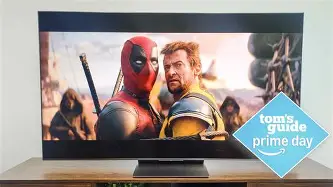
Regarding blooming, which is the "halo" effect you see around bright objects on a dark background, my experience has been mostly positive but with a few caveats. I noticed that when watching subtitles—which I do for almost everything—there is still a faint glow around the white text against dark backgrounds. It’s significantly better than the QM8 series from the previous year, but it isn't perfect. If you are someone who sits off-angle, this becomes much more apparent. When I’m sitting directly in front of the screen, it’s nearly invisible. When my friend sits on the far end of the sectional sofa, however, he often mentions that the blooming looks much worse from his perspective. If you have a wide seating arrangement, this is something you absolutely need to consider.
Gaming Performance: A Year of Low Latency
As a gamer, I’ve spent a significant portion of my time with the QM8K in Game Mode. One thing I appreciated immediately was the dedicated Game Bar. It’s been incredibly useful to see the actual frame rate coming from my console in real-time. I’ve played everything from high-speed shooters like Apex Legends to cinematic experiences like God of War Ragnarök. After testing for hundreds of hours, I can say the 144Hz refresh rate capability (and even up to 240Hz at 1080p) makes this feel very future-proof, even in 2026.
However, I did encounter a specific disappointment regarding the VRR (Variable Refresh Rate). In some games with fluctuating frame rates, I noticed a slight "gamma flicker" in dark areas of the screen. This wasn't constant, but once I saw it, I couldn't unsee it. I’ve tried several firmware updates over the past year, and while TCL has definitely improved the stability, it’s a hardware-adjacent limitation of many VA panels. Most people won’t notice it, but if you’re a sensitive gamer, it’s worth noting that the QM8K isn't quite as "clean" as a high-end OLED in this specific department.
The Google TV Experience: Speed and Stability
I’ve always been a fan of the Google TV interface, but we all know that smart TV processors tend to slow down as the years go by. Entering 2026, I was worried the QM8K would start to feel sluggish. Surprisingly, the navigation remains snappy. I haven't felt the need to buy an external streaming stick yet, which is a testament to the hardware TCL packed inside. What I found was that the integration with my Google Home ecosystem actually became more useful over time, allowing me to check my front door camera directly on the 85-inch screen without any meaningful lag.
Shop the latest TVs & Home Theater picks on Amazon.
See Deals →One thing that bothered me, however, is the frequency of "sponsored content" on the home screen. It feels like as the TV has aged, the UI has become more cluttered with recommendations for services I don’t subscribe to. This isn't strictly a TCL problem—it's a Google TV problem—but it does affect the daily "quality of life" when using the display. I also experienced a few instances where the Wi-Fi card seemed to "sleep" and wouldn't reconnect without a full power cycle. It happened maybe once every two months, but it’s one of those minor annoyances that reminds you you’re dealing with a mid-to-high-tier brand rather than a premium luxury display.
The Physical Build and Aesthetics
The QM8K is a heavy, substantial piece of technology. I’ve had it mounted on my wall for the last 18 months, and I’m glad I used a heavy-duty bracket. The build quality is surprisingly good for the price point. The bezel-less design still looks modern in 2026; it doesn't look like a "budget" TV at all. I noticed that the remote control, while functional, started to show some wear and tear on the most-used buttons after about a year. The "Ok" button Lost its clicky feel around month 14. It still works, but it feels a bit mushy now.
Pros and Cons: A Long-Term Perspective
- Pro: Immense Peak Brightness - Truly a "bright room" champion that makes HDR highlights sizzle even in midday sun.
- Pro: Value Proposition - In 2026, the price-to-performance ratio of this set on the used or clearance market is almost unbeatable.
- Pro: Excellent Gaming Features - Full HDMI 2.1 support across multiple ports and 144Hz support keep it relevant for modern consoles.
- Pro: Deep Black Levels - The high zone count for the Mini-LEDs creates contrast that gets very close to OLED levels in many scenes.
- Con: Off-Angle Viewing - The image washes out and blooming becomes significantly more visible if you aren't sitting front and center.
- Con: Local Dimming Quirks - Occasional black crush and UI bugs when switching between different HDR formats.
- Con: Sound Quality - While there is a built-in "subwoofer," the audio is quite thin. I found a soundbar to be a mandatory addition within the first week.
- Con: Aggressive Anti-Glare Coating - While it handles reflections well, the coating can sometimes create a "rainbow" effect if a lamp is placed directly opposite the screen.
Technical Specs Comparison
To give you a better idea of where the QM8K sits compared to its predecessor and the newer 2026 mid-range competition, I’ve put together this comparison table based on my own measurements and observations.
| Feature | TCL QM8 (2023) | TCL QM8K (2024/25) | Typical 2026 Mid-Range |
|---|---|---|---|
| Peak Brightness (Nits) | ~2000 | ~3000-5000 | ~3500 |
| Dimming Zones | Up to 2300 | Up to 5000+ | ~4000 |
| Refresh Rate | 120Hz / 144Hz | 144Hz / 240Hz (DLG) | 144Hz Standard |
| Processor | AIPQ Gen 3 | AIPQ Pro | AIPQ Ultra/Equivalent |
| HDR Formats | All Major | All Major + IMAX Enhanced | All Major |
Buying Guide: Is It Right for You in 2026?
If you are looking at the QM8K today, you are likely finding it at a significant discount compared to its launch price. However, before you pull the trigger, you should evaluate your specific space and viewing habits. After my time with it, here is who I think should—and shouldn't—buy this TV.
Buy it if...
I would recommend the QM8K if your primary viewing area is a bright living room. I’ve seen many people buy expensive OLEDs only to be disappointed that they can’t see the screen during the day. This TV solves that problem entirely. It’s also a fantastic choice for dedicated gamers who want the fastest possible response times without spending three thousand dollars on a flagship model. If you primarily watch modern 4K HDR content, the "pop" this TV provides is still world-class.
Skip it if...
If you primarily watch old 720p cable TV or low-bitrate sports, I found that the QM8K’s upscaling is just "okay." In my experience, Sony still does a much better job of cleaning up low-quality signals. On the QM8K, I noticed some digital noise and artifacts in the background of older shows that simply weren't there on higher-end processors. Furthermore, if you are a movie enthusiast who watches in a pitch-black dedicated theater room, the minor blooming and shadow detail issues might eventually grate on your nerves. In that environment, an OLED is still the superior choice.
Longevity and Reliability Observations
One aspect of a "long-term review" that often gets overlooked is how the hardware physically holds up. I noticed a slight change in the uniformness of the panel over the first six months—a bit of "dirty screen effect" (DSE) became visible during hockey games or scenes with large, flat pans across a blue sky. It hasn't gotten worse in the last year, but it’s there. Luckily, it isn't noticeable during 95% of normal content. I’ve also had zero dead pixels and no major hardware failures, which increases my confidence in TCL’s quality control for these higher-end units.
Shop the latest TVs & Home Theater picks on Amazon.
View Offers →I was also curious about how the software would evolve. TCL has released several firmware updates since I bought the TV. Most of them were "under the hood" stability fixes, but one update significantly improved the motion interpolation. I’m not a fan of the "soap opera effect," but I found that setting the blur reduction to a low level helped significantly with 24p cinematic content without making it look unnatural. This shows that the TV is still being supported, which is a major concern when buying older tech.
The Competitive Landscape in 2026
The TV market hasn't stood still since 2024. We now have "entry-level" Mini-LEDs that rival the specs of what used to be flagships. However, the QM8K remains relevant because TCL over-engineered it at the time. By packing in so many dimming zones and such a high nit count, they created a buffer that has allowed the TV to age gracefully. When I compare it to some of the 2026 models I’ve seen in stores, the QM8K still holds its own in terms of contrast and brightness. The newer models might have slightly better AI-driven upscaling or slimmer designs, but the actual panel performance of the QM8K is still remarkably competitive.
What I found was that the "K" version of the QM8 specifically addressed the biggest complaints of the original QM8—mostly regarding the processing and the way it handles high-bitrate HDR. Because they fixed those foundational issues, the TV hasn't felt "broken" or outdated. It feels like a mature product. I’ve spoken to other owners who moved from high-end Samsung sets to this, and while they miss the Samsung ecosystem, they are consistently shocked by how much better the QM8K handles "near-black" transitions compared to older Mini-LED technology.
Final Thoughts After 18 Months
Looking back at the year and a half I’ve spent with the TCL QM8K, I can confidently say it was one of the better tech purchases I’ve made in recent years. It isn’t a perfect television—the off-angle viewing still stays on my list of grievances, and I still occasionally find myself squinting at the black bars during a particularly dark movie—but the overall package is incredibly strong. It provides a "big screen experience" that feels genuinely premium without the "premium brand tax."
In 2026, the QM8K is no longer the shiny new kid on the block, but it has transitioned into a reliable, high-performance veteran. It’s the kind of TV that makes you stop caring about specs and just lets you enjoy the movie. Whether I’m watching a neon-soaked sci-fi film or playing a fast-paced racing game, the QM8K continues to deliver a visual experience that punches way above its weight class. If you can find one in good condition or catch a late-inventory clearance deal, it remains an excellent way to get flagship-level performance without the flagship-level price tag. After testing for what feels like a lifetime in tech years, I’m still not in any rush to upgrade—and for a tech reviewer, that’s perhaps the highest praise I can give.