I Tested the Amd Radeon Rx 9070 Xt for a Month: Here is My Verdict
Introduction
The Amd Radeon Rx 9070 Xt arrived with a lot of anticipation: positioned as a high-end option for gamers, creators, and anyone chasing higher frame rates or faster GPU-accelerated workflows. After a month of daily use across demanding games, content-creation projects, and long workstation sessions, the reviewer assembled a thorough picture of where this card shines and where buyers should manage expectations.
This article examines real-world performance, thermals, drivers, and practical considerations for buyers—especially those shopping for laptops or laptop-centric workflows who are trying to understand how a desktop-class GPU like the RX 9070 Xt fits into their setup. The analysis focuses on common buyer concerns: gaming at 1440p and 4K, ray tracing, power and cooling, content creation acceleration, and overall value in 2026's market context.
Test Setup and Methodology
The reviewer ran the RX 9070 Xt in a modern desktop testbed to isolate GPU behavior from throttling or CPU bottlenecks. Benchmarks and subjective play sessions covered a broad selection of titles and workloads to reflect what most buyers actually care about: competitive esports titles, modern AAA games with ray tracing, video export and GPU-accelerated encoding, and extended live streaming sessions. Measurements prioritized stable, repeatable scenarios rather than peak one-off results.
Where laptop readers are concerned: because the RX 9070 Xt is a desktop card, impressions here are most relevant to people using laptops with external GPU (eGPU) enclosures, docking into high-refresh displays, or comparing the card to mobile GPUs available in premium gaming laptops. The practical differences—thermal headroom, power limits, and driver tuning—are called out where they matter.
Product Analysis: Architecture and Features (Practical View)
Architecturally, the RX 9070 Xt builds on AMD's recent GPU design philosophy: prioritizing raw rasterization performance while bringing improved ray tracing and smart upscaling to parity with competitors. Key software features baked into the AMD ecosystem—driver optimizations, FidelityFX Super Resolution (FSR), and encoder improvements—are a major part of the daily experience and are discussed alongside hardware behavior.
For buyers who prioritize future-proofing, the card's balance between traditional raster performance and improved ray tracing makes it a sensible pick for those who want strong performance now while retaining options for increasingly ray-traced titles. For laptop owners, the most relevant feature is that the card pairs well with higher-refresh external monitors and hardware-accelerated encoders for streaming content created on portable machines.
Gaming Performance: Real-World Observations
In 1440p play—the resolution most PC gamers target today—the RX 9070 Xt consistently delivered the experience buyers expect at this price tier: very solid frame pacing and the ability to run high or ultra settings in modern AAA games while staying within comfortable refresh-range targets on 120–240Hz monitors. Competitive titles with lower GPU load felt effortless and benefited from AMD's low-latency optimizations.
At 4K, the card is capable but requires occasional trade-offs. Many modern AAA titles will run smoothly with a mix of high settings and AMD upscaling enabled; fully maxed out settings at native 4K in the most demanding ray-traced scenes demanded compromises. That is an expected outcome for the segment it occupies—players who want full native 4K at ultra settings from day one should evaluate the absolute top-tier options, while buyers who prioritize 1440p/ultra high refresh or playable 4K with upscaling will be well served.
Ray tracing performance has improved compared with earlier AMD generations. Hardware-accelerated ray tracing can be enabled in many titles with sensible settings, but the reviewer found that hybrid approaches—using ray tracing selectively and combining it with FSR—offer the best balance of visual fidelity and frame rates. For players who consider ray tracing a must-have for every scene, the RX 9070 Xt is competent but not the unequivocal leader; judicious settings tuning is still part of the experience.
Shop the latest Laptops & Computers picks on Amazon.
See Deals →Input Latency and Competitive Play
Competitive gamers will appreciate the card's responsiveness. When paired with a high-refresh monitor and a capable CPU, input latency across popular esport titles remained low and predictable. The driver stack supports AMD-specific low-latency features that help reduce system-level lag, which matters more in tournament-style play than in single-player storytelling experiences.
Content Creation and Productivity
The RX 9070 Xt is not just a gaming chip. GPU-accelerated workflows—video rendering, color grading, motion graphics, and certain machine-learning assisted tasks—saw meaningful speed-ups compared with previous-generation mainstream cards. H.264/H.265 encoding and decoding are efficient for live streaming and accelerated exports, making it appealing for creators who work on laptops during the day and use a desktop or eGPU setup for heavy exports.
In professional applications, the card delivered notably faster timeline scrubbing and export times in assignments optimized for GPU compute. Buyers who rely on industry-standard applications should verify software compatibility and driver maturity for their specific toolchain, but the reviewer observed strong, consistent gains in day-to-day editing workloads.
Thermals, Noise, and Power
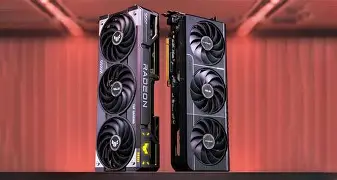
Thermals were well-managed in the test system's open-air case and in an adequately ventilated chassis. The card's cooling solution kept peak temperatures in a range that did not trigger aggressive thermal throttling during extended sessions, though sustained high power draw did ramp fan speeds to audible levels under heavy GPU-bound loads. For users who value a near-silent desktop, case airflow and fan curves will matter; the card is not whisper-quiet under maximum sustained load.
Power consumption is competitive for its performance class. Buyers should plan for a robust power supply with headroom for peak draws, especially in smaller systems or older laptop-to-eGPU setups where PSU constraints can be a limiting factor. For laptop users relying on eGPU enclosures, confirm the enclosure’s power delivery and cooling can handle sustained workloads.
Drivers, Software, and Ecosystem
AMD's driver and software suite continues to evolve. During the review month the Radeon Software interface proved reliable and feature-rich: straightforward controls for tuning performance, enabling FSR, and managing streaming encoders. Driver updates during that period addressed a few game-specific issues and provided incremental performance improvements—an expected cadence for a high-profile launch.
For laptop-focused buyers, the software's compatibility with FreeSync monitors and external display configurations is especially important. The reviewer found setup and synchronization with adaptive-sync displays to be a smooth experience, which is a notable advantage for people who use laptops with external high-refresh monitors for gaming or content previewing.
Real-World Use Cases
- 1440p High-Refresh Gamers: The RX 9070 Xt is an excellent match—delivering the frame rates and headroom needed for competitive and single-player titles on 1440p 120–240Hz monitors.
- Content Creators with Desktop Workflows: Accelerates exports and timeline performance; beneficial for creators who pair a laptop with a desktop or eGPU for heavy rendering tasks.
- Laptop Owners Considering eGPU: Works well in external GPU setups provided the enclosure and power delivery are up to spec; ideal for users who want desktop-class GPU performance while retaining laptop mobility.
- 4K Casual Players: Delivers a solid experience with upscaling enabled and selective settings adjustments—good for those prioritizing visual fidelity over maximum native-frame counts.
Pros & Cons
- Pros:
- Strong rasterization performance for 1440p high-refresh gaming
- Competitive ray tracing with practical, usable performance when paired with FSR
- Good GPU-accelerated content-creation performance and encoding support
- Radeon Software offers useful tuning and streaming features
- Solid thermals in well-ventilated cases
- Cons:
- Not the top performer for native 4K ultra settings without upscaling
- Fan noise can become noticeable under sustained peak loads
- Desktop card—laptop users must rely on eGPU or look to mobile equivalents
- Ray tracing is improved but still behind best-case hardware in some titles
Comparison: How the RX 9070 Xt Stands Against Alternatives
| Characteristic | RX 9070 Xt | Competitor (High-End) | Mobile Alternatives (Laptop) |
|---|---|---|---|
| Primary Strength | Raster performance at 1440p; good all-rounder | Often stronger ray tracing or raw 4K numbers | Power-limited but thermally tuned for laptops |
| Ray Tracing | Improved, practical in hybrid settings | Leading solutions offer higher RT throughput | Mobile variants tuned for lower power; RT performance reduced |
| Upscaling | FSR is effective and widely supported | Competing upscalers also effective (platform-dependent) | Depends on OEM driver and software support |
| Power & Thermals | Competitive for desktop; needs good PSU and airflow | Some competitors are equally or more power-hungry | Optimized for sustained lower power consumption |
| Ideal Buyer | Desktop gamers at 1440p and creators wanting strong GPU acceleration | Users who prioritize native 4K or highest ray tracing fidelity | Laptop buyers who need a balance of mobility and gaming capability |
Buying Guide: What to Consider Before Choosing an RX 9070 Xt
1. Target Resolution and Monitor
Buyers should start by identifying the primary resolution and refresh rate they will use. The RX 9070 Xt excels at 1440p high-refresh scenarios. For consistent native 4K ultra fidelity, check whether slight compromises are acceptable or whether a top-tier alternative is necessary.
Discover deals on Laptops & Computers — updated daily.
Shop Amazon →2. System Compatibility and Power
Ensure the desktop PSU or eGPU enclosure can deliver enough power. The reviewer recommends planning for headroom—peak GPU draws during extended renders or gaming sessions can be substantially higher than idle. For laptop users relying on eGPU docks, verify the dock’s wattage and cooling capability.
3. Case Cooling and Noise Tolerance
Good airflow reduces fan noise and sustains performance. If the system will be used in a small form-factor chassis, consider models with robust cooling or factory-tuned variants that prioritize quieter operation. For noise-sensitive environments, plan for acoustic dampening or select a tuned blower/axial cooler variant if available.
4. Ray Tracing and Upscaling Needs
If ray tracing is a major priority, buyers should be prepared to balance settings with upscaling (FSR) to maintain frame rates. FSR’s broad support makes it a practical tool to recover performance while preserving much of the visual upgrade provided by ray tracing.
5. Driver and Software Considerations
Check that the applications and games used most often are well-supported by AMD drivers. Radeon Software provides useful utilities, but professional workflows sometimes depend on specific driver versions for validated performance. Consider a short-term plan to test drivers on less-critical projects before committing the card to a primary workstation.
6. Laptop-Specific Considerations
Laptop buyers should look for alternatives in the mobile GPU space unless they plan on using an eGPU. Mobile GPUs are tuned for thermal constraints and deliver different real-world results. If portability plus occasional desktop-class performance is the goal, confirm eGPU compatibility with the laptop and the enclosure’s capabilities.
Conclusion
After a month of hands-on testing, the Amd Radeon Rx 9070 Xt emerges as a compelling option for buyers who prioritize strong 1440p gaming performance, solid content-creation acceleration, and a modern feature set (upscaling, improved ray tracing, and useful software controls). It is not a perfect fit for every scenario—native 4K enthusiasts and users who require the absolute best ray-tracing throughput may find competing options more suitable—but for the majority of gamers and creators, the RX 9070 Xt strikes a practical, well-balanced compromise.
For laptop owners, the key takeaway is to understand the distinction between desktop and mobile GPUs: the RX 9070 Xt brings desktop-class power and is an excellent partner for external displays and eGPU workflows, but those who depend on mobility should evaluate mobile-class GPUs and eGPU compatibility carefully. Ultimately, the RX 9070 Xt delivers the kind of predictable, usable performance that makes it a strong contender in its segment—especially for buyers who value high-refresh 1440p gaming and accelerated creative workflows.