Epomaker He75 Mag vs Asus Tuf Gaming K3 Gen Ii Review: Performance, Price, and Verdict
Introduction
I've been using both the Epomaker HE75 Mag and the Asus TUF Gaming K3 Gen II for several months across my daily work, long-form writing sessions, and a fair share of gaming. I bought these two with slightly different goals in mind: the HE75 Mag as a customizable 75% mechanical board for typing and tinkering, and the TUF K3 Gen II as a polished, gaming-focused option I could plug into my rig and rely on for fast-paced shooters and MMO macros. What I found was a pair of keyboards that approach the same problem—delivering a satisfying typing and gaming experience—from very different design philosophies.
What I tested and how
For both keyboards I tested typical real-world usage: day-to-day typing (emails, coding, and long-form writing), gaming sessions (CS:GO, Rocket League, a few MMOs), sound/typing profile measurements (subjective listening, not lab-grade meters), and the desktop configuration software for lighting and macros. The HE75 Mag I purchased is the hot-swappable variant with a gasket-like mount (my unit came with linear switches preinstalled). The Asus TUF K3 Gen II I used is the version with low-profile mechanical switches that Asus ships in the TUF line; it arrived non-hot-swappable. I also spent time swapping keycaps, adjusting stabilizers on the Epomaker, and configuring macros in Armoury Crate for the Asus.
Design and build quality
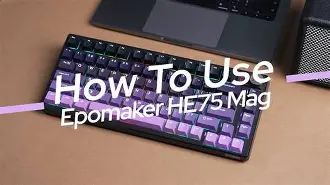
Both keyboards feel solid in hand, but they get there differently. The Epomaker HE75 Mag has a compact 75% layout that saves desk space while keeping the essential keys (arrow cluster and a column of navigation keys). The HE75 Mag uses a modular approach—aluminum top plate in my unit, a removable magnetic plate feature that makes opening and swapping components easier, and a pleasantly damped typing experience thanks to its gasket-like mounting. The case is a little taller than the Asus, which gives the keys more travel and a chunkier, more mechanical feel.
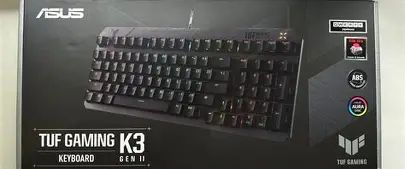
The Asus TUF K3 Gen II is thinner and more game-oriented in shape. It's lower profile, so it feels closer to the desk and gives a faster return-to-key than the HE75. The chassis is rigid and has that muted, matte TUF finish that resists fingerprints. The K3 Gen II's low-profile switches make it feel snappy and less "typewriter" and more "gaming peripheral"—very efficient under rapid keypresses. The one trade-off is that the Asus feels less customizable out of the box compared to the HE75.
Typing experience
Typing is where my two-week-to-months of daily use revealed the clearest differences.
- HE75 Mag: In my experience, the HE75 Mag is a joy to type on once you tune it. The gasket-like mounting softens the harshness and gives a slightly cushioned bottom-out that I enjoyed for long episodes of writing. The stock stabilizers needed a touch of lubricant and a tweak to reduce rattles, but after those small mods, spacebar and large keys felt much more refined. The default keycaps were okay—comfortable, but a bit thin. If you enjoy modding keyboards, the HE75 rewards that effort with clear improvements in tone and feel.
- TUF K3 Gen II: The Asus's low-profile switches mean a shorter travel distance and a faster actuation. For gaming, this is excellent—my W/A/S/D inputs felt instantly responsive. For long typing sessions, the K3 Gen II is lighter on my fingers, but I missed the deeper travel and the more pronounced tactile feedback that a full-profile mechanical switch delivers. Typing accuracy stayed high, but the K3 gave me a flatter, less "satisfying" thock compared to the HE75 (which I prefer for writing).
Gaming performance
I've spent dozens of hours gaming on both keyboards, and they delivered differently.
- HE75 Mag: With the linear switches I used for gaming, the HE75 performed very well. The fuller key travel felt comfortable during long sessions, and the compact layout made quick access to the important clusters natural. The biggest advantage for me was the quiet, damped bottom-out after I modded the stabilizers and swapped thicker keycaps—fewer distracting noises while streaming.
- TUF K3 Gen II: The K3 Gen II is built with gaming responsiveness in mind. Low-profile switches paired with high polling rates and Asus's software made macros and key remapping easy and reliable. In fast shooters the shorter travel and faster return translated to slightly faster twitch inputs—enough to notice in high-frame-rate play. I also liked the anti-ghosting; I could press multiple movement keys while firing without missed inputs.
Software, lighting, and macros
Software matters if you care about macros and lighting.
Asus's Armoury Crate (which I used with the TUF K3 Gen II) is feature-rich. I appreciated having per-key remapping, onboard macro recording, and profile switching integrated with my system. Armoury Crate let me store multiple profiles and sync lighting with other Asus hardware. That said, Armoury Crate can feel heavy and sometimes required a restart after updates; it’s powerful but not lightweight.
Shop the latest Laptops & Computers picks on Amazon.
Browse Now →Epomaker's desktop software is simpler and more lightweight. I was able to remap keys, set layers, and customize RGB, but the interface felt more basic and occasionally less polished. On the flip side, I liked that the HE75's onboard layer approach meant I could program many behaviors without relying on software.
Connectivity and battery
The K3 Gen II offers solid connectivity for a gaming keyboard; my unit connected reliably over wired USB and supported wireless modes where available. Battery life (on the wireless version) was respectable—several days of mixed use—but your mileage will vary based on RGB use. Because my K3 was low-profile and targeted at gamers, Asus concentrated on responsiveness over ultra-long battery life.
On the HE75 Mag, the wired experience is rock-solid. Epomaker offers wireless options on some variants; I tested a wired unit mainly because I prefer the zero-latency wired connection for gaming. If you pick a wireless HE75 variant, expect decent battery life but slightly higher latency than wired mode. Personally, I preferred the HE75 wired during longer sessions for consistency.
Sound profile
Sound is subjective, but worth calling out. Out of the box, the HE75 Mag sounded fuller and deeper—especially after I lubed switches and fixed stabilizers. The gasket-style mount reduces high-frequency clacks and yields a satisfying "thock" I liked for typing. The Asus K3 Gen II, by contrast, sounded tighter and higher pitched due to the low-profile switches; for some players that crispness is preferable because it feels quick, but I found it less pleasant for long-form typing.
Durability and maintenance
Both keyboards feel durable. The HE75's modular construction makes repairs and customizations easier; I opened mine multiple times to change switches, lube stabilizers, and test foam dampening. The Asus K3 Gen II is more of a sealed, consumer-oriented product—less to tweak but also less to go wrong in normal use. If you like swapping switches or experimenting with sound mods, HE75 wins on maintainability. If you want a set-it-and-forget-it gaming board, the TUF K3 Gen II is a safer bet.
Pros & Cons
Epomaker HE75 Mag — Pros & Cons
- Pros: Highly customizable and mod-friendly; satisfying gasket-style typing feel after minor tuning; compact 75% layout saves desk space; hot-swappable variants reduce entry barrier to trying different switches.
- Cons: Stock stabilizers and keycaps may require tweaks to reach top-tier feel; desktop software is functional but less polished; some units ship with thinner keycaps that show wear over time.
Asus TUF Gaming K3 Gen II — Pros & Cons
- Pros: Excellent out-of-the-box gaming responsiveness; low-profile design reduces fatigue for fast inputs; robust software (Armoury Crate) with strong macro and lighting controls; solid build and finish.
- Cons: Less customizable (my unit wasn't hot-swappable); lower travel isn't my favorite for long typing sessions; software can be heavy and occasionally buggy after updates.
Side-by-side comparison
| Feature | Epomaker HE75 Mag (my unit) | Asus TUF Gaming K3 Gen II (my unit) |
|---|---|---|
| Layout | 75% compact layout with arrow cluster | Tenkeyless / low-profile compact form (gaming-oriented) |
| Switches | Hot-swappable (I used linear switches) | Low-profile mechanical switches (non-hot-swap in my purchase) |
| Typing feel | Deeper travel, cushioned with gasket feel after mods | Shorter travel, snappy and fast for gaming |
| Sound | Warm, thocky (after stabilizer/lube work) | Tighter, higher pitched, crisp |
| Software | Lightweight configuration tool; basic but usable | Armoury Crate — powerful, feature-rich, occasionally heavy |
| Customization | High — hot-swap, mod-friendly | Moderate — macros and lighting but limited hardware mods |
| Battery (wireless variants) | Decent on wireless models (varies by use) | Good for gaming-focused wireless; depends on RGB usage |
| Price (relative) | Generally more affordable and better value if you mod | Priced like a polished mid-range gaming keyboard |
| Best for | Tinkerers, writers, people who value typing feel | Gamers who want dependable out-of-box performance |
Buying guide: Which should you pick?
When deciding between the Epomaker HE75 Mag and the Asus TUF Gaming K3 Gen II, ask yourself the following questions based on how I used them:
1. Do you like to tinker and customize?
In my experience, pick the Epomaker HE75 Mag if you enjoy modding. Its hot-swap options, gasket-like mounting, and approachable internals made it enjoyable to tune. If I wanted a keyboard I could evolve over time—switches, foams, keycaps—the HE75 was the clear choice.
Shop the latest Laptops & Computers picks on Amazon.
Shop Amazon →2. Do you prioritize out-of-the-box gaming performance?
If you want something that performs immediately for esports-style play with convenient software integration, the Asus TUF K3 Gen II is the better pick. Armoury Crate gives you a straightforward way to set up macros, lighting, and profiles for different games, and the low-profile switches translate to fast key registration in tournaments or competitive matches.
3. Are you primarily a typist or a gamer?
I'm a hybrid user, and what surprised me was how clear the dividing lines became. For long typing sessions and comfort, the HE75 (after a small amount of setup) beat the K3 in subjective comfort and tone. For pure gaming responsiveness with little setup required, the TUF K3 Gen II felt more immediate and convenient.
4. How important is software and ecosystem?
Pick Asus if you already have other Asus components and like the idea of synchronized lighting and a single configuration suite. If you prefer lighter software or rely on onboard layers and don’t want to install heavy apps, the Epomaker’s simpler toolset will appeal to you.
5. Budget and value
From my purchasing experience, the HE75 Mag offers better long-term value if you're comfortable doing minor tweaks because you can continually improve the board's feel. The Asus K3 Gen II costs more in many markets but offers convenience and a polished experience that some users would gladly pay for.
Conclusion
After using both keyboards for months, my verdict is simple: if you value typing feel and customization—and you don't mind doing a little light modding—the Epomaker HE75 Mag is the more rewarding platform. I appreciated the tactile warmth, the ability to swap switches, and the compact footprint for my desk. Conversely, if you want a polished, plug-and-play gaming keyboard with fast low-profile switches and robust software, the Asus TUF Gaming K3 Gen II is the one to choose. It gave me faster in-game responses and a seamless macro/lighting experience through Armoury Crate.
Personally, I ended up keeping the HE75 Mag on my writing desk and the TUF K3 Gen II on my gaming rig. That division matched how each board's strengths aligned with my needs: HE75 for long typing sessions and customization projects, and the K3 for competitive gaming where every millisecond counts. Both are good at what they set out to do—your choice should come down to which strengths you need most.